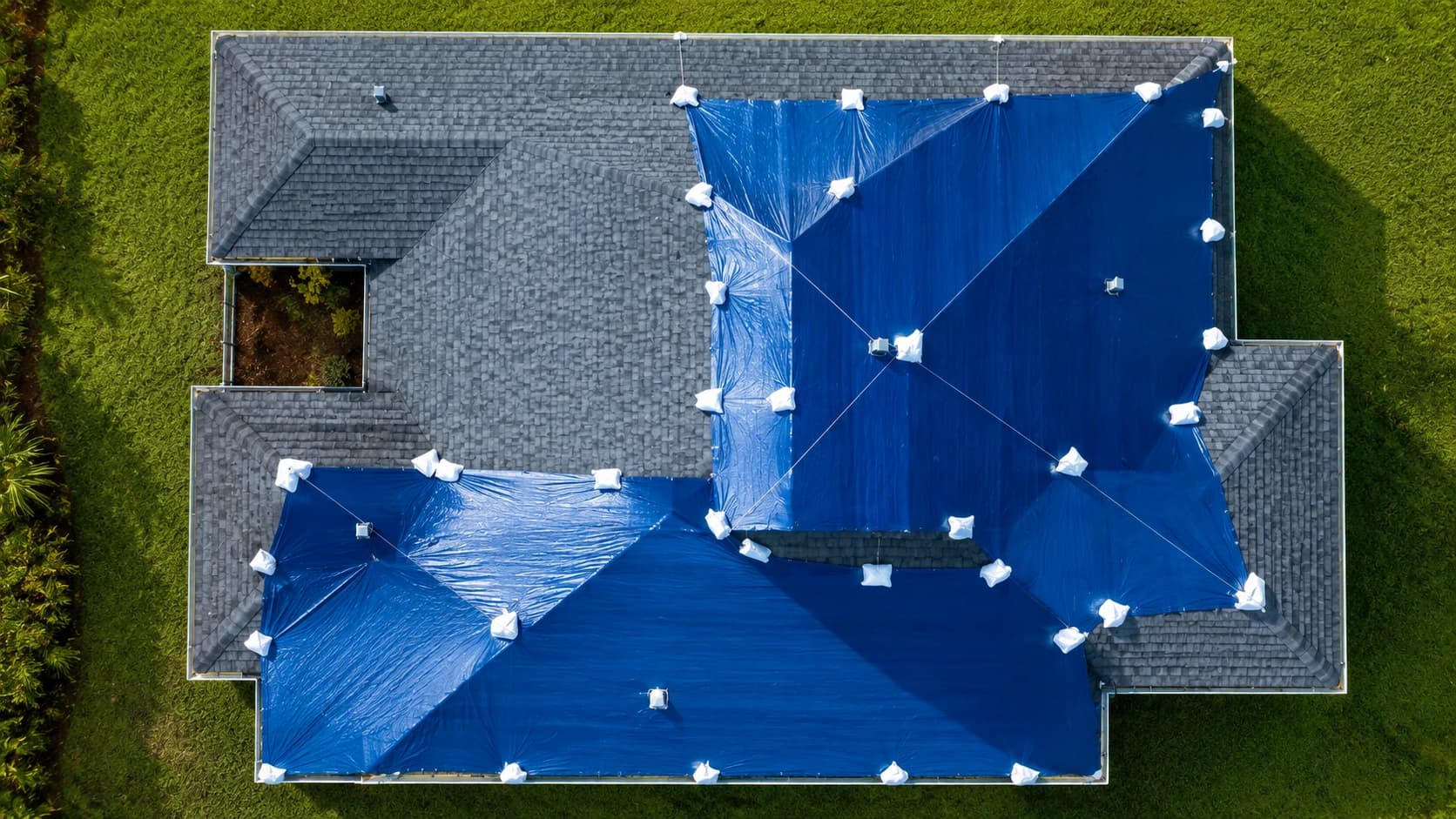
Emergency roof tarping — what it covers, what it costs, and why timing is everything.
A tarp isn't a repair. It's a stopgap that prevents a bad situation from becoming a catastrophe. Understand what it covers, how it interacts with your insurance claim, and why waiting 48 hours costs more than acting immediately.
Emergency tarping available after major storms. Serving coastal NC.
Emergency tarping — the difference between a claim and a disaster.
When a storm leaves an open hole in your roof — from a tree impact, missing shingles over a large area, or structural failure — every hour without protection is another hour of potential water intrusion. Emergency tarping involves securing heavy-duty polyethylene sheeting over the damaged area to prevent rain from entering the home while a permanent solution is assessed and scheduled.
What it is
Temporary protection — polyethylene tarps secured to prevent further water entry. It is not a repair.
What it prevents
Secondary damage — interior water damage that occurs after the storm and could be excluded from your claim if you didn't take reasonable mitigation steps.
How long it lasts
Days to weeks — tarps are temporary. Permanent repairs should be scheduled as quickly as the claims process allows.
The 24-hour window — why delays cost more than the tarp.
Hour 0
Storm passes
The storm has passed. The damage is done. The clock is now running.
Hour 1–6
Open exposure
Every subsequent rain event, morning dew, and humidity adds to the moisture in your framing, insulation, and drywall. Wet wood swells. Insulation compresses and loses R-value. Mold begins developing within 24–48 hours in warm, humid conditions.
Hour 24
Secondary damage threshold
Most insurers draw a distinction between storm damage and secondary damage — interior deterioration that occurred after the storm because mitigation wasn't taken. Secondary damage can be excluded from your claim.
Hour 48+
Mold risk
In coastal NC's warm, humid climate, mold can begin colonizing wet materials within 24–48 hours of initial water exposure. Remediation costs are significant and may be limited or excluded by your policy.
Day 3+
Interior damage compounds
Ceiling drywall saturates and begins to fail. Insulation holds moisture against framing. Electrical in wet walls becomes a safety concern. What started as a $6,000 roof repair can become a $30,000 interior loss.
Is emergency tarping covered by insurance?
Yes — in virtually every case where the underlying damage is covered, emergency tarping is also covered as part of the loss mitigation. Your insurer expects you to take reasonable steps to prevent additional damage. A tarp is that step.
01
Document before tarping
Photograph the open damage before the tarp goes on. The adjuster needs to see the original condition.
02
Keep all receipts
Tarping costs are typically reimbursed as part of the claim. Document materials, labor, and time.
03
Don't delay waiting for adjuster approval
Insurers expect prompt mitigation. Waiting for adjuster authorization to tarp is not required — and waiting can hurt your claim.
Watch for AOB language. If a contractor asks you to sign over your claim rights (Assignment of Benefits / AOB) before they'll tarp your roof — walk away. That's not standard practice and not in your interest.
What a tarp protects — and what it doesn't.
What tarping protects
- Open holes from fallen trees or wind-lifted panels
- Large areas of missing shingles with exposed decking
- Failed or removed skylights
- Damaged ridge sections with exposed substrate
- Any area where rain can directly enter the home
What tarping does NOT do
- Fix the underlying damage
- Prevent all moisture (edges, wind-driven rain, condensation)
- Guarantee no further damage in extreme conditions
- Replace permanent repair or replacement
- Eliminate the need for a full inspection and scope
What homeowners ask us about emergency tarping.
How much does emergency tarping cost?
Can I tarp my own roof?
What if it rains again before the adjuster comes?
How is emergency tarping different from a roof repair?
Does tarping affect my insurance claim?
Storm damage with open exposure? Call now.
We respond to emergency tarping requests in the Wilmington and coastal NC area. We document the damage before securing the tarp — protecting both your home and your claim.
More storm damage and claims resources from Caliber Roofing.